

Optimizing Network Capacity Through Shared Spectrum Solutions
- March 5, 2025
As the demand for connectivity grows, telecommunications providers face significant challenges managing rapid growth and cost of their network infrastructure. Shared spectrum solutions offer a promising answer, using innovative technology to maximize spectrum availability, efficiency, and affordability. This article explores shared spectrum solutions and how they are revolutionizing telecommunications services by improving the immediacy and availability of bandwidth on high growth routes.
Jaime Goldenberg
Director of Presales & Product Development, Trans Americas Fiber
Understanding Shared Spectrum Solutions
Shared spectrum solutions are based on technologies designed to enable the secure use and sharing of fiber pairs within the same subsea cable by multiple telecommunications providers. Unlike traditional fixed capacity models, often dependent upon, and limited by, supplier forecasting and capital investment cycles, spectrum sharing makes spectrum resources immediately available on a fiber pair, thus allowing multiple telecommunications providers to simultaneously utilize the submarine cable infrastructure, independently managing their own capacity growth and investment.
This approach can be segmented into:
Spectrum Sharing Models:
Includes co-ownership, Indefeasible Right of Use (IRU) agreements, or consortiums that share spectrum or a fiber pair.
Technology Implementation:
Optical spectrum allocation allows the telecommunications provider to choose their own Submarine Line Terminal Equipment (SLTE), decide their own capacity ramp up, and reserve spectrum for growth on key routes.
Challenges of Spectrum Sharing Solutions
While shared spectrum solutions bring significant benefits, they are not without challenges. The complexity of shared infrastructure introduces various technical, operational, and strategic difficulties:
Technical Complexity
Managing spectrum sharing involves sophisticated technology that can handle different operators with distinct needs and specifications. Ensuring that shared optical spectrum remains interference-free while maintaining service quality demands.
Interoperability Issues
Operators often have proprietary systems that may not seamlessly integrate with ITU Standards based shared spectrum infrastructure. The coordination between different technologies and systems can create unintended bottlenecks, optical power level variances and limit the full potential of shared spectrum solutions. The current move towards higher baud rate WDM channels, with spectral widths of 150-200 GHz, also needs to be considered.
Ssecurity concerns
Sharing infrastructure raises concerns about data privacy, security, network integrity and performance. Unauthorized access, changes or data breaches can potentially affect multiple stakeholders, making cybersecurity protocols, spectrum management and allocation controls essential yet challenging to coordinate across different parties.
TAM-1 Advantage, Enhancing Bandwidth Utilization
The demand for high-speed, reliable, and scalable data transmission across the Americas has never been more critical. Trans Americas Fiber is revolutionizing connectivity with its TAM-1 subsea cable system, state-of-the-art infrastructure designed to address the exponential growth in data traffic. In this section I review the specific elements of the TAM-1 design that enable spectrum sharing solutions for our customers.
Creating Advanced Spectrum Connectivity Solutions
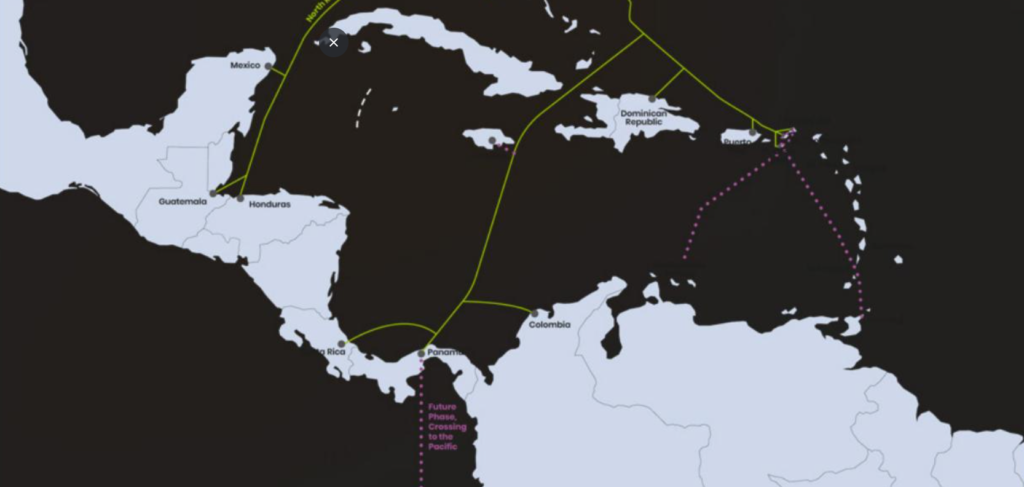
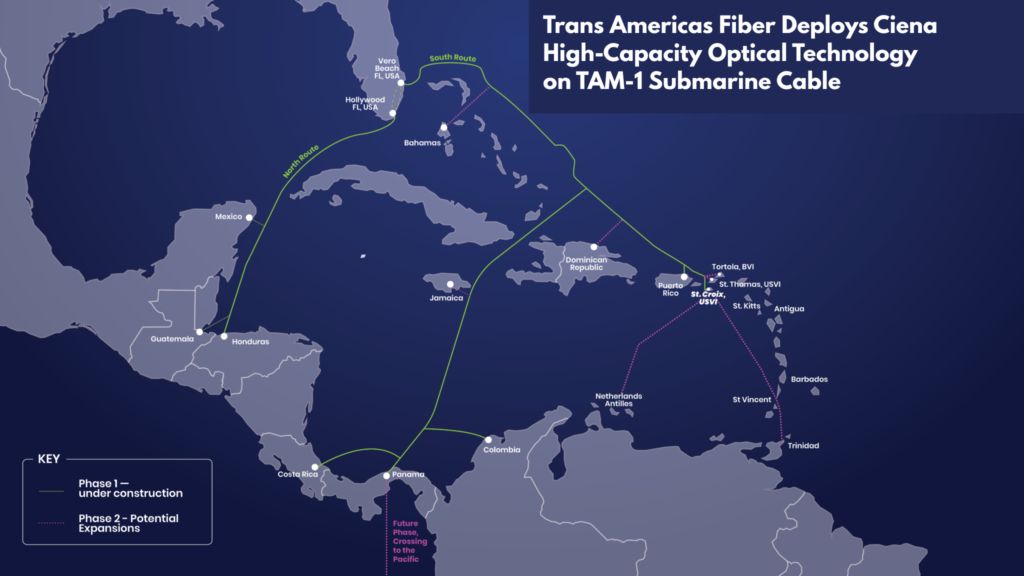
The TAM-1 system spans over 7,200km subsea, connecting Florida with Central America and the Caribbean. The network is designed to provide low-latency, high-reliability connectivity, which is essential for modern digital ecosystems. It consists of a north and a south system, consisting of 12 fiber pairs on the north system and 24 fiber pairs on the south system, creating a design capacity of 648Tbps, representing a massive step change compared to the legacy systems currently operating in the region.
The primary spectrum related feature of TAM-1 is the Spectrum Sharing Gateway (SSG), which is one variant of Xtera’s Open Cable Interface (OCI) equipment and housed in the cable landing stations. The SSG allows a number of WDM terminals or SLTEs to connect to a single fiber pair, facilitating multiple customers to operate spectrum simultaneously on the same fiber pair.
Each terminal is assigned a unique part of the available bandwidth, with the SSG ensuring that the terminals are isolated from each other in a way that safeguards against issues on one terminal affecting another. This security is ensured by wavelength filtering to control access to the shared spectrum and monitoring the input signals so that dummy loading can be inserted in the event of missing signals; this might occur due to the failure or disconnection of a terminal. Up to eight terminals can be supported and the assignment of spectrum is flexible down to 6.25 GHz. This fine granularity, and transparency to any data format, means that the system offers a high degree of flexibility with regards to both current and future traffic types.
OADM BU capability is the second feature of TAM-1 which facilitates flexibility of spectrum allocation on a fiber pair. Xtera’s Switched Band OADM (SB-OADM) unit is a subsea module that can be installed in a branch cable, sufficiently far from the Branching Unit such that it can be installed or repaired without disturbing the Branching Unit.
It performs a similar function to a subsea ROADM based on Wavelength-Selective Switches (WSSs) but is of simpler construction, requires less maintenance at a lower cost. It achieves this by switching bands of wavelengths rather than access down to individual wavelengths. The bands are chosen prior to manufacture and are fixed, but the OADM unit can be reconfigured to vary which bands are accessed at a branch at any time – giving our customers increased flexibility of spectrum availability on their traffic paths.
The switches latch, thus preserving the Add/Drop reconfiguration even if the system is depowered. Due to the relative simplicity of the module, it requires only a very simple control system and is easy for the TAM-1 Network Operations Center (NOC) to manage. By enabling these two discrete types of spectrum management, TAM-1 will be able to offer flexibility and efficiency to operators, allowing them to scale their networks in response to fluctuating demand over time.
Related Post
-
 Beyond the Cable: Building the Digital Backbone for the Next Generation of the Americas
 -
 TAM-1: Redefining Regional Connectivity Across the Americas
 -
 TAFS Deploys Ciena High-Capacity Optical Technology On TAM-1 Submarine Cable
 -
 Optimizing Network Capacity Through Shared Spectrum Solutions
 -
 Securing Connectivity In The Digital Era

Copyright 2026, Trans Americas Fiber. All Rights Reserverd.
- Terms of Services
- Privacy Policy